
Swastikars
Long before Elon Musk, car company owners have involved themselves in fascistic or other dubious political activities.

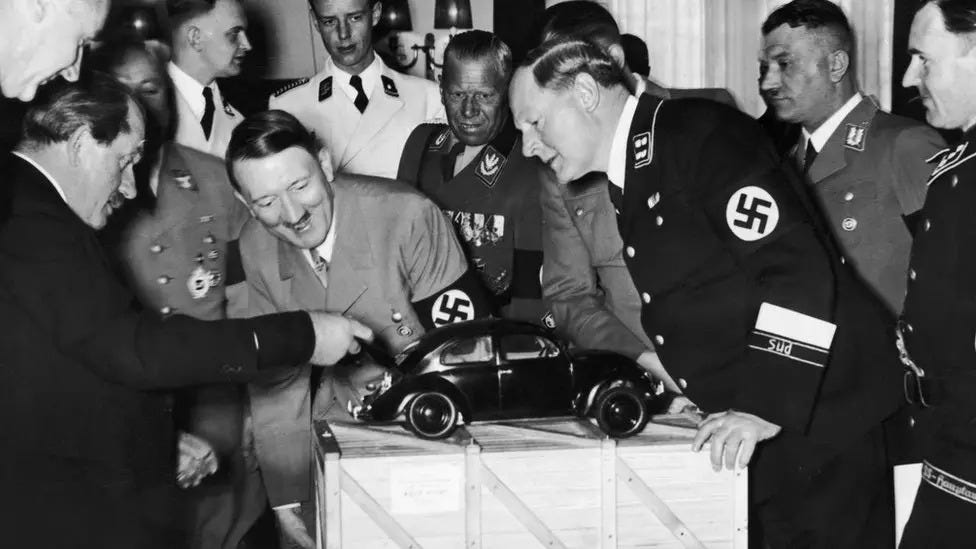
Adolf Hitler inspects a prototype model of the Volkswagen. Image source: BBC News.
When Elon Musk stomped through the federal government the way Godzilla stomps through Tokyo, dissidents targeted the most obvious symbol of his business enterprises — Tesla electric vehicles.
The term “swastikar” emerged in social media to smear Teslas as somehow emblematic of a new era of fascism, the second coming of Nazi Germany.
Teslas were vandalized across the nation. The New York Times reported on April 3 that Teslas had swastikas spray-painted on the hood or carved into the paint. One car in Brooklyn had “NAZIS” spray-painted on it.
Elon Plays Politics
It wasn’t long ago that owning a Tesla meant you were a progressive environmentalist, protecting Mother Earth from the greenhouse gas emissions spewing from the tailpipe of an internal combustion engine.
The stereotype wasn’t quite true. A 2019 Climate Nexus survey found that 84% of Democrats viewed electric vehicles positively, 75% of independents, and even 70% of Republicans.
In early 2022, CNN Business reported a Morning Consult survey that found 22% of Democrats were considering buying a Tesla, but so were 17% of Republicans. The article also cited data collected by Strategic Vision which showed that since 2019 38% of Tesla owners identified as Democratic and 30% as Republican.
By the end of 2022, the stereotype was gone. Musk took offense that President Joe Biden excluded him and Tesla from an August 2021 White House electric vehicle summit. Pundits speculated that Musk was snubbed because Tesla is a nonunion shop. Musk is anti-union, and has long sparred with the United Auto Workers. Elon began attacking Democrats; on May 18, 2022, he posted on Twitter that he would only vote Republican in the future. He called Democrats “the party of division & hate.”
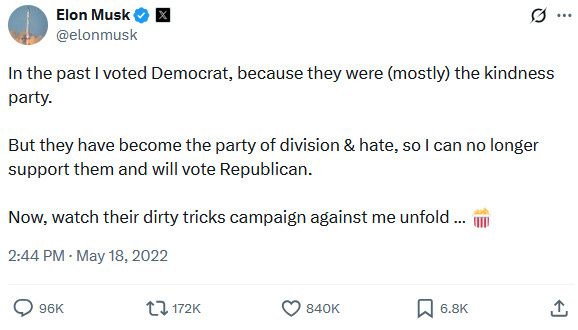
Elon Musk’s May 18, 2022 tweet disavowing the Democratic party. Image source: X.com.
In October 2022, he purchased Twitter, changed the name to X, and used it to promote his political beliefs and business interests.
Musk’s behavior shifted Tesla’s popularity away from its core demographic. The Wall Street Journal reported on November 29, 2022 that Tesla’s reputation had eroded in parallel with Musk’s political activism:
Tesla’s net favorability among self-described Democrats in the U.S. fell to an average of 10.4% this month through Nov. 27, down from an average of 24.8% in October, according to Morning Consult. It rose to 26.5% from 20% among self-described Republicans during the same period.
In 2024, Musk spent $288 million to support the campaigns of Donald Trump for president and for Republican candidates. Trump rewarded Musk by appointing him as a special advisor. Elon was turned loose on the federal government, using his “Department of Government Efficiency” (DOGE) to fire federal employees without rhyme or reason, including agencies that regulated Tesla and his other businesses.
Progressives called Musk a fascist and a Nazi. Teslas were called “swastikars” and became targets for vandalism.
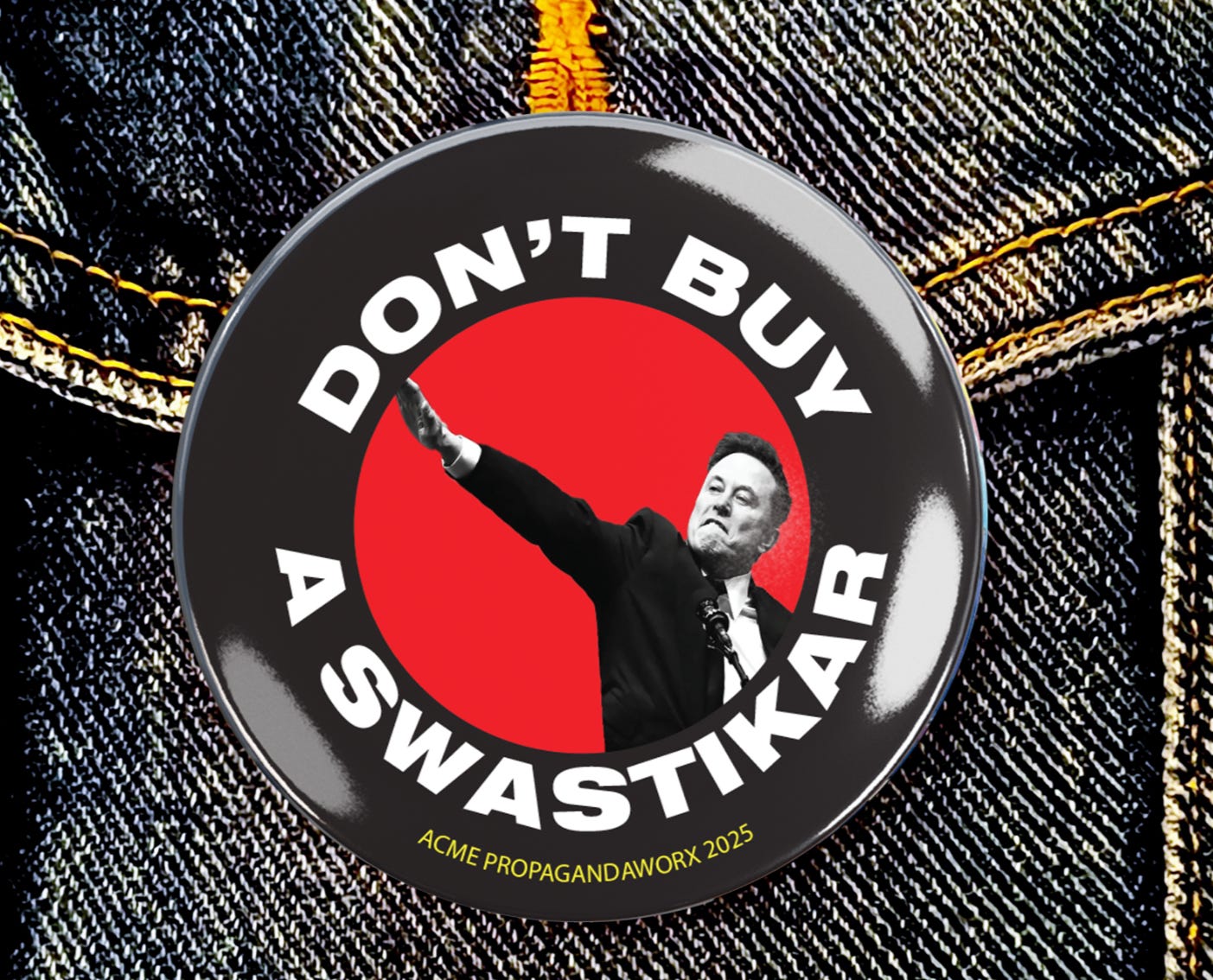
An Elon Musk “swastikar” protest button available on eBay.
Tesla owners became targets for angry progressives, which seems illogical since many Tesla owners are themselves progressive. Some progressives sold off their Teslas rather than be condemned by their peers as ideologically impure.
A November 2024 survey showed that Democrats were still more likely than Republicans to consider buying an electric vehicle. Just not a Tesla. Republicans who were open to buying an EV were now more likely to consider a Tesla.
The conservative buyers weren’t enough to help Tesla’s sales numbers. At the end of 2025’s first quarter, Tesla’s automotive revenue plunged 20% from the year before.
When Musk left the White House at the end of May to tend to Tesla and his other businesses, the damage was done not just to the federal government, but also to his name and the Tesla brand.
The First Swastikar
Fascism in its modern context arose in the 1930s with Germany’s Adolf Hitler and Italy’s Benito Mussolini.
The Council on Foreign Relations has a webpage on fascism. The Council defines fascism as “a mass political movement that emphasizes extreme nationalism, militarism, and the supremacy of the nation over the individual.”
The Foundation for Economic Education notes that 1930s fascism had an economic component known as “corporatism.” An example of this in Nazi Germany is what one might call the first “swastikar,” the Volkswagen.
In German, “Volkswagen” meant a “people’s car” that Hitler envisioned providing the masses with affordable transportation. According to the United States Holocaust Memorial Museum, automobiles in 1930s Germany were a luxury, so Hitler viewed the Volkswagen as bringing automobile travel to the masses. Hitler in 1938 predicted that the Volkswagen would become “a symbol of the National Socialist people's community.”
Germans were issued savings books to put away money for the day they could buy a Volkswagen, but World War II changed that. Volkswagen was one of the first German companies to use forced labor — Soviet prisoners of war, Soviet and Polish civilian forced laborers, and of course Jews. Some of the Jews came from Auschwitz. A concentration camp was built at the factory to house the slaves.
Volkswagen largely escaped accountability for its treatment of slaves until the 1990s, when the company paid reparations to its surviving victims and their families.
The company remains far from clean, so to speak. In 2015, the company was found to have cheated on meeting its US emission standards, and paid a multi-billion dollar fine.
Have You Driven a Swastikar Lately?
Ford Motor Company founder Henry Ford was an open anti-Semite. In 1919, he published the Dearborn Independent so he could promote his political views, including his conspiracy theories about Jews. Starting in 1920, the paper included his column titled, “The International Jew: The World's Problem” which each week claimed a global Jewish conspiracy theory.
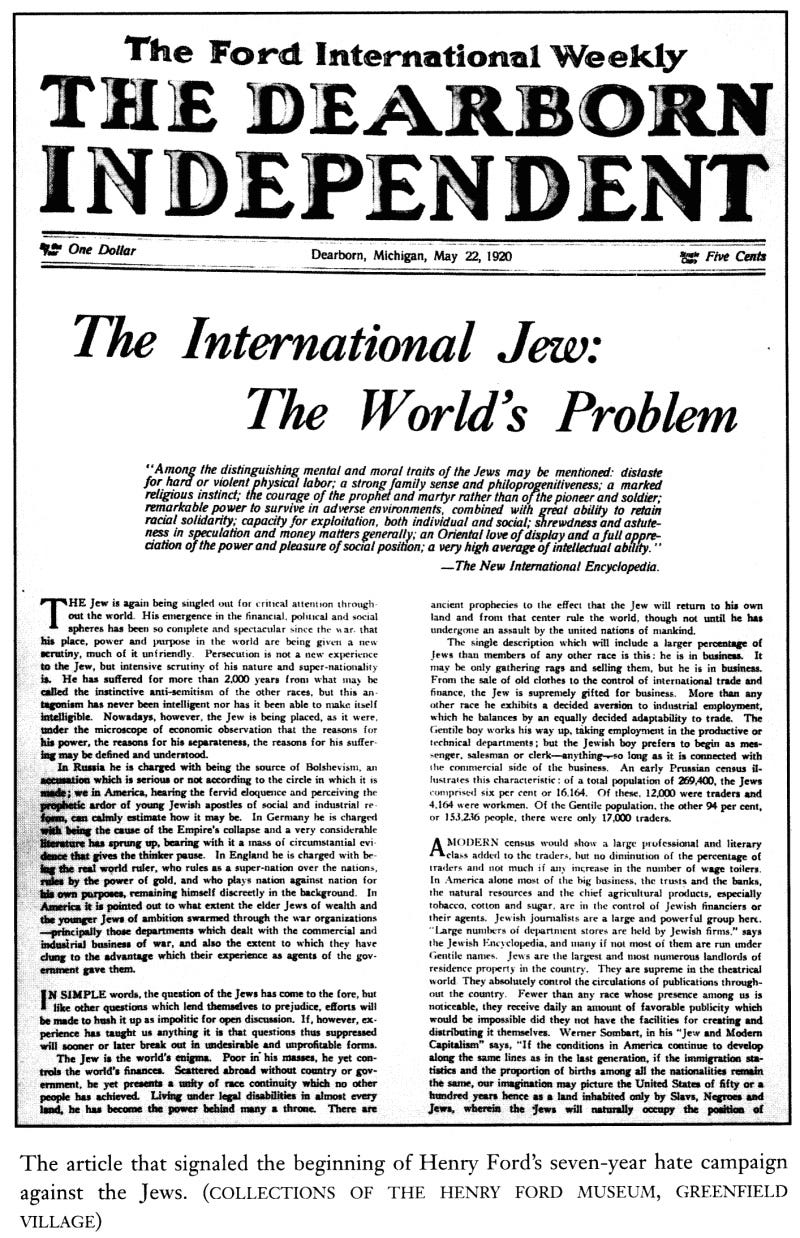
The first issue of Henry Ford’s anti-Semitic conspiracy theory series. Image source: Wikipedia.
To quote from the Henry Ford museum website:
Ford saw Jews present in everything that he viewed as modern and distasteful — contemporary music, movies, theater, new dress styles, and loosening social mores.
Ten years before he became chancellor, Adolf Hitler in 1923 professed his admiration for “Heinrich” Ford. According to Max Wallace, the author of the 2003 book The American Axis, rumors circulated that Ford financially supported Hitler’s National Socialist party, but it was never proven. Hitler copied ideas from “The American Jew” and cited Ford in Mein Kampf as “independently” standing up to the Jewish “controlling masters of the labor power of a people of 120,000,000 souls …”
In 1938, on Ford’s 75th birthday, Hitler awarded him the Grand Service Cross of the Supreme Order of the German Eagle. The motor company by then had established a subsidiary in Germany.
During World War II, Ford supported the war effort and publicly denounced anti-Semitism. Ford’s US plants were converted to support the war, while in Germany the subsidiary, Ford Werke, fell under the direct control of the Nazi government. As with Volkswagen, Ford Werke used forced labor.
Henry Ford’s mass production techniques were a strong influence on Nazi German industry in the 1930s. One can argue that the Volkswagen was similar in sentiment to the Ford Model-T — a cheaply produced “people’s car” for the masses. Volkswagen executives visited the United States to tour automobile factories and hire away engineers, many of them from Ford. But Hitler also viewed the Ford car company as a potential rival for German manufacturers; in 1936, he issued a secret order forbidding Nazi party offices from buying Fords. By the late 1930s, the Ministry of Propaganda ordered German newspapers not to report on Ford products for fear they might challenge Volkswagen for car sales in the country.
Nobody’s Perfect
Those seeking an ideologically pure alternative to a Tesla product have a long search ahead of them.
Ford, Stellantis, Hyundai, and General Motors each donated $1 million to Trump’s inauguration fund. Other media report that Toyota also contributed $1 million. If you wish to remain ideologically pure, you must rule out purchasing a car from any of these companies.
Two smaller EV companies, Rivian and Lucid, arguably are the most appealing to the principled progressive, but that progressive better be well off.
The price for a Rivian R1S seven-passenger RV starts at $75,900, according to their website. Rivian doesn’t offer a vehicle comparable to Tesla’s Model 3 sedan or Model Y compact SUV, although the website promotes a R2 compact SUV coming in 2026 for $45,000 that might be in the same category as the newly updated Model Y. In November 2024, Rivian entered into a $5.8 billion joint venture with Volkswagen, the original producers of a “swastikar,” so you may wish to question their ideological purity as well.
Lucid offers the Air Pure as its bargain-basement vehicle, starting at $69,900, but the Pure and its siblings are more in the category of the Tesla Model S luxury sedan which starts at $84,990. Lucid’s primary shareholder is the Ayar Third Investment Company, an affiliate of the Public Investment Fund, the sovereign wealth fund of Saudi Arabia. PIF’s chairman is Mohammed bin Salman Al Saud, the notorious “MBS” alleged to have ordered the assassination of Washington Post journalist Jamal Khashoggi. If you’re not happy with MBS or his authoritarian regime, then perhaps Lucid is not for you either.
According to Consumer Reports, for 2025 the EV tax credits became more stringent. The Tesla Models 3 and Y qualify. Lucid still qualifies because it hasn’t yet reached certain sales thresholds. Rivian vehicles are no longer eligible.
The budget bill recently passed by Congress eliminates EV tax credits on October 1, so the deadline might start a rush on EV sales lots during the next three months as buyers seek to save on their car purchase. The tax credit allows a buyer to transfer the tax credit to the seller; that would lower the purchase price for a new 2026 Tesla Model Y to a minimum of $37,490.
It will be very difficult, if not impossible, to find an ideologically pure EV with equivalent features for that price, even with tax credits.
A January 2025 Self Financial study using Forbes Advisor data concluded that, over the years 2022-2024, the least expensive car to operate was a Tesla Model 3 — not just an EV, but any car. The Tesla Model Y was #7. The cars inbetween all had internal combustion engines. The Model S was #20. No other EV made the list, although the Honda CR-V hybrid ranked #10. The article concluded:
According to the study, choosing an electric car isn’t just an eco-friendly option – it’s good for your wallet too. Considering the three Tesla models in the study (Model 3, Model Y, and Model S), the average cost to run a Tesla car is $5,517 per year.
Even though Tesla sales are down, it’s likely that the company will be around for a long time — longer than Elon Musk, who presumably is mortal. (But Tesla is working on artificially intelligent Optimus robots. Maybe he’ll try to copy his intelligence into one.)
Just as the Ford Motor Company outlived Henry Ford, just as Volkswagen outlived Adolf Hitler, Tesla will outlive Elon Musk.
Automotive industry publisher Edmunds ranks the 2025 Tesla Model 3 Long Range as the best electric car, and the 2026 Tesla Model Y Long Range (also known as “Juniper” edition) as the best electric SUV.
If you can’t live with a Tesla, check Edmunds and other sources for options such as Hyundai and its Kia subsidiary. Hyundai EVs are made in Georgia, and Kia is starting to shift its US EV production from South Korea to Georgia. Just remember that Hyundai gave $1 million to Trump’s inauguration, so you might find those brands impure as well.
It’s not easy to be perfect.